
Hydrangeas are some of my favorite plants but unfortunately the summer weather in Grass Valley is not conducive to growing them. There are many days in July and August when the temperature reaches over 100 degrees and the Hydrangeas wilt.

I have installed a mister for each plant that increases the humidity. The plants do better with higher humidity and plenty of water.


Hydrangea arborescens ‘Annabelle’ new flower above and old flower below. One of the best white Hydrangeas. Photos taken at Legacy Christian School in Auburn, CA.


 Hydrangea arborescens ‘Annabelle’ in December.
This is a good dried flower that will last for years inside.
 Hydrangea ‘Vanilla Strawberry’


Hydrangea macrophylla ‘Pistachio’


Hydrangea grandiflora new, blue and old over a period of 2 months.
You can change the color of many Hydrangeas by changing the soil Ph by applying aluminum sulfate or acid fertilizers. Acid soils produce blue flowers and alkaline soils produce pink flowers. Aluminum sulfate will produce acid soils and lime will produce alkaline soils. Purple is the transition color.


 Hydrangea macrophylla ‘Cityline Paris’


Lacecap Hydrangeas have an outer ring of petaled sterile flowers surrounding a mass of tiny fertile flowers.
 A new double pink Hydrangea


Hydrangea flowers last a long time as cut flowers and also outside on the plant. The photo below was taken in December after blooming on the plant since July:

 Some leaves turn purple in December due to the cold.


 Notice how the Oakleaf Hydrangea flowers turn pink later in the season.


Oakleaf Hydrangea (Hydrangea quercifolia) has beautiful branches with flaking bark and great fall color.

 Before and after pruning Oakleaf Hydrangea. 
 Hydrangea quercifolia ‘Pee Wee’

 Hydrangea quercifolia ‘Munchkin’

 Hydrangea quercifolia ‘Ruby Slippers’
 Hydrangea quercifolia ‘Little Honey’


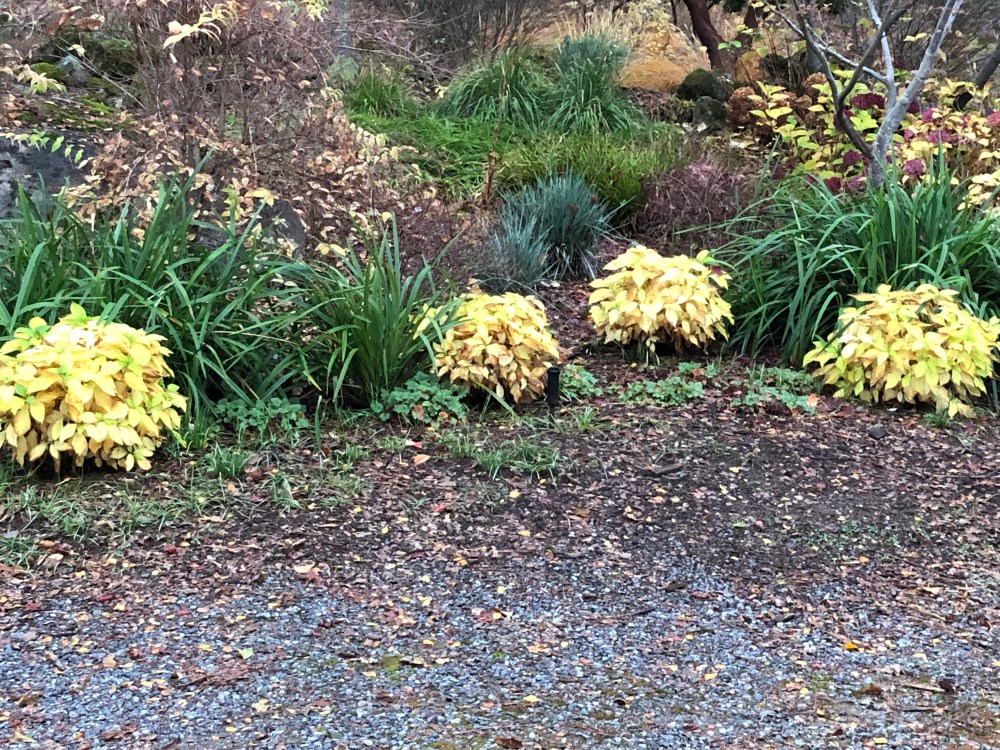
Hydrangea ‘Hornli’ flowers and fall color

 Hydrangea ‘Hornli’ before and after pruning.

 Hydrangea paniculata ‘Vanilla Strawberry’ in July.

‘Vanilla Strawberry’ in September.

 Hydrangea paniculata and H. arborescens


 Hydrangea arborescens ‘Annabelle’ around bottom pond
 Burned flowers of Hydrangea ‘Annabelle’ after temperatures of 112 degrees.

 Hydrangea paniculata ‘BoBo’
 Hydrangea semanii is an evergreen slow growing vine.
Hydrangeas are usually pruned in December or January along with roses. This is an example of a properly pruned Hydrangea. Some varieties may not bloom the following year if pruned this severely. For those H. grandiflora varieties just remove the stem with the flowers; the other stems will bloom the next year.

 This is what the Hydrangea garden looks like after pruning. Note the old flowers laying on the ground still have some color in December:


This is a Hydrangea bouquet picked in December:

Hydrangea garden photos taken June, 2022:


Hydrangea look-alike: Dichroa febrifuga:


 June
June
 July
July Dichroa febrifuga in December